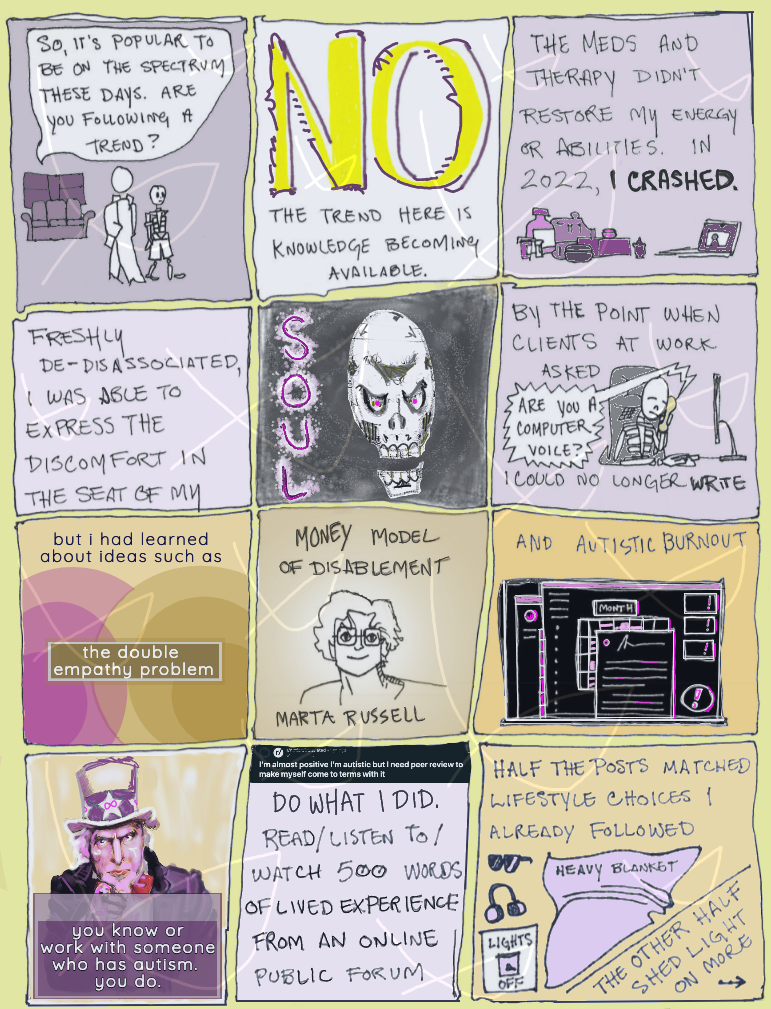
click here for a wikipedia entry on the double empathy problem
here is an excellent introduction video to the models of disability and to Marta Russell
The money model, best articulated in Russell’s 1998 book, Beyond Ramps: Disability at the End of the Social Contract, posits that disabled people are not, as they are often framed in dominant culture, a “burden to society,” but are actually a valuable resource. As Russell explains: “…persons who do not offer a body which will enhance profitmaking as laborers are used to shore up US capitalism by other means.” Disabled people are a nexus around which the capacity for surplus labor power can be built (often financed in part by federal money)—whole sectors of our economy have sprung forth from the money model, which has normalized the commodification of things, systems, and places that maintain disabled bodies in pursuit of squeezing profit from the money which passes through disabled people towards their survival and care. For example, nursing homes, Russell argued, are not places of rest and comfort, but a strategy for commodifying the “least productive” so that they can both be “made of use to the economic order” and free up the labor supply of those who love and wish to care for them. This system benefits neither the workers nor disabled people, only what Russell called the “owning class.” US disability policy, instead of being oriented around supporting the needs of disabled people, sanctions and facilitates the capitalist capture of nearly all aspects of disablement, impairment, chronic illness, and disability, including the way that “reasonable accommodations” are commodified (as explored by Ruth Colker in her essay for this symposium).
click for Capitalism & Disability: A Symposium on the Work of Marta Russell by Beatrice Adler-Bolton and Artie Vierkant
click here for a wikipedia paragraph on autistic burnout. the article on autism also says there’s at least one of us per hundred people. knowing someone on the spectrum is a statistical inevitability